Issue 02 · One essay
Soil Deficiencies
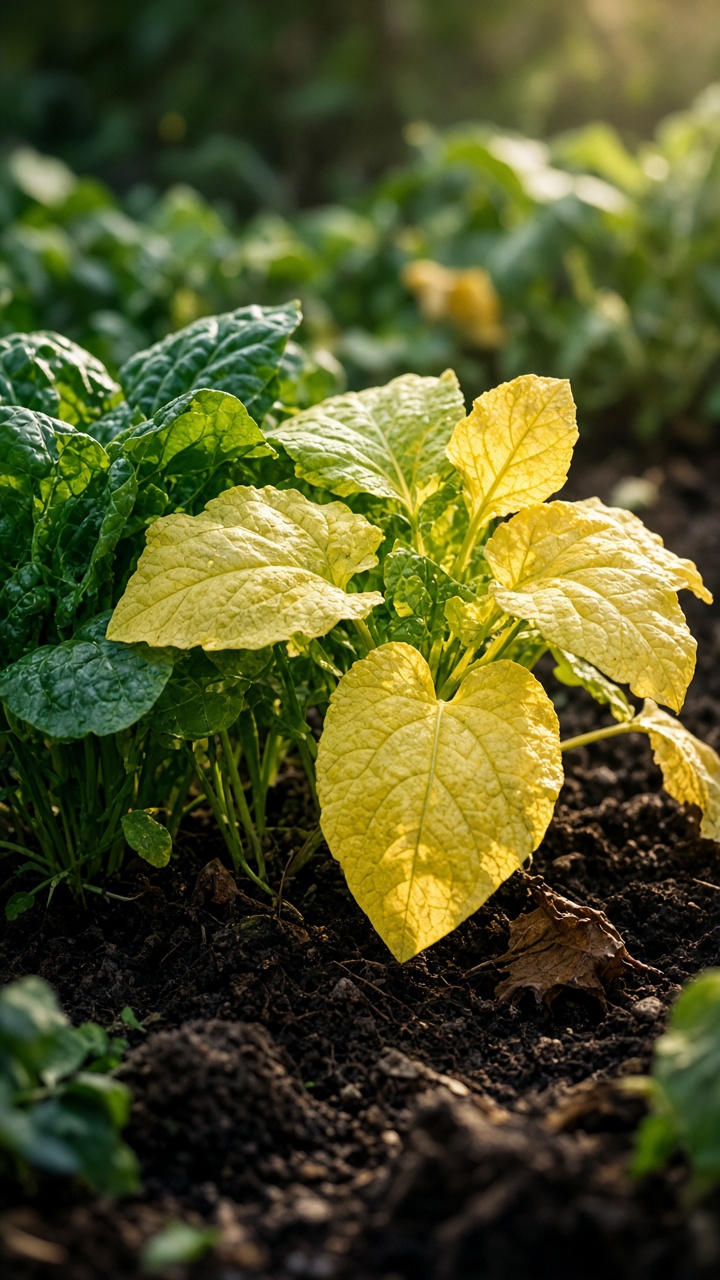
Yellow leaves tell a story — if you read the whole garden, not a single plant in isolation.
s take a few minutes to discuss the various soil deficiencies you may run in to in your garden. Before treating your soil for a nutrient deficiency, make sure to pay close attention to all plant symptoms. Many of the deficiencies listed below show similar symptoms of: deformed leaves, stunted leaves, yellow leaves, weak stems, and premature dropping of fruit. Therefore, look at your garden as a whole. Are all of your plants suffering from the same symptoms, or is it only your tomatoes? Questions like this will help in identifying the exact nutrient deficiency, and eliminate others that may have similar symptoms.
“If a plant starts to lose its green color, the amount of chlorophyll has been reduced — and so has its ability to create energy.”
Soil Deficiencies
Since the most common symptom has to do with plants not being as green as they should, let
When a light is shined on an object it will absorb certain colors of light and reflect other colors.
The colors of light that an object reflects determines what colors our eyes pick up, and therefore determines what color the object is. For example, a red apple appears red because the pigment in the apple
s skin absorbs blue and green light, and reflects red.
Plants are green for a very similar reason. Plants receive their energy to grow through a process known as photosynthesis, or the plants ability to turn sunlight in to energy. Sunlight is made up of a mixture of red, green and blue light.
The chlorophyll in a plant absorbs the red and blue light from the sunlight and converts it in to a form of energy the plant can use to grow, and reflects the green light so plants appear to be green to our eyes.
So in most cases, there is a direct correlation between the green color of a plant's leaves and the health of the plant. If a plant does not have enough chlorophyll to absorb sunlight, the plant will not have enough energy to grow. If a plant starts to loose its green color, and looks more yellow green, then the amount of chlorophyll in the plant has been reduced, as well as the plants ability to create energy. Nutrient deficiencies either directly or indirectly affect a plants chlorophyll levels, and if a plants chlorophyll levels are too low, the plant will die.
Nitrogen is essential to photosynthesis and healthy cell growth and reproduction. It is vital in producing chlorophyll (which gives leaves good green color) and amino acids. It also promotes shoot and leaf growth. Nitrogen is the most used nutrient by plants and therefore it is the most common nutrient deficiency suffered by plants. Nitrogen deficiency can occur when woody material such as sawdust is added to the soil. Soil bacteria will use the nitrogen in the soil, which was intended for your plants, to break down the sawdust. This is known as
All vegetables, except for nitrogen fixing legumes (like peas), are prone to this disorder. Short term prevention can be achieved by using grass clippings as a mulch, and a longer term solution is to build up the levels of organic matter in the soil.
Phosphorus is required for cell growth and plant reproduction, and it is crucial for flower and fruit formation.
Phosphorus deficiency is often misdiagnosed as a virus disease.
Potassium activates plant enzymes, keeps cell fluid movement in balance, and is necessary for root formation and food storage in the plant.
Calcium is needed for cell division and plant growth. Its buffering characteristics are critical to soil balance and largely determine the availability of other nutrients.
Sulfur increases the protein content of crops and stimulates more rapid root development during the early growth period. Almost all garden soils suffer from an inherent sulfur deficiency. A moderate to high level of sulfur is especially required for potatoes.
Uniform yellowing and mild upward curling of leaves.
Nitrogen deficiency shows confusingly similar symptoms.
Magnesium (often confused with manganese, a minor nutrient) is an essential element of chlorophyll.
When calcium and magnesium levels are not in balance, the availability of many other nutrients is affected adversely. Minor nutrients produce best results when the calcium/magnesium ratio is close to 68:12.
Boron is the most widely deficient minor nutrient in vegetable crop soils. It is needed in protein synthesis, and increases flower set, crop yield and quality. In combination with adequate phosphorus, boron increases pollination, fruit set and seed development. Boron deficiency is often caused by application of too much lime. While boron is essential for root growth and fruit development, it can become toxic in high amounts.
Plants have small, crinkled, deformed leaves, with large areas of discoloration.
Manganese accelerates seed germination and accelerates the ripening of crops.
Iron is essential for plants to make chlorophyll, therefore is also known as Lime-Induced Chlorosis. Iron plays a role in the synthesis of plant proteins. Iron deficiency most often occurs when iron is made unavailable for plant absorption due to improper soil pH factors. Iron deficiency will begin to appear in soils have a pH factor above 6.8. Improper drainage is the most common cause of high pH levels in soil. Over fertilization can also lead to iron deficiency by causing elements like calcium, zinc, manganese, phosphorus, and copper can tie up iron if they are present in high quantities.
Leaves turning yellow or brown in the margins between the veins.
Young leaves may remain green or appear to be bleached.
Raspberries and pears are particularly susceptible.
Zinc aids in moisture absorption and in the production of chlorophyll.
Small narrow leaves with black spots in yellow areas of tomatoes.
Copper increases flavor and sugar content of vegetables and fruits. It increases color intensity and yield of carrots, spinach, onions, corn and cabbage. Soils with high levels of organic matter form a bond with copper causing copper deficiency. While most soils are copper deficient, a small amount is a necessary component of plant growth, but too much copper can be toxic to plant roots and leaves. Copper should not be applied before having the soil professionally tested.
Plants are extremely susceptible to airborne fungal diseases.
N-P-K at a glance
The three macronutrients every fertilizer conversation returns to.