Issue 03 · One essay
Osmosis
Why salt levels decide whether roots drink — or give water back to the soil.
Osmosis is by far the most important process that occurs in a garden. Osmosis is the chemical process used by a plant to absorb nutrients into the plant. It gives plant roots the ability to absorbed water from the soil. Osmosis is technically defined as, "The movement of water across a semi permeable membrane from an area of high water potential (low solute concentration) to an area of low water potential (high solute concentration)." In a solution, the substance being dissolved is called the solute and the liquid it is dissolved into is known as the solvent. For example, when fertilizer is added to soil, the nutrients of the fertilizers are dissolved by the water in the soil. Therefore the nutrients from the fertilizer, or the solutes, are dissolved into the water of the soil.
“All of this biological magic is solely dependent upon one thing: the salt levels of the soil.”
Osmosis
We mentioned earlier how we need to be aware of the salt levels of our soil, but how does the salt level of our soil effect plant health? Suppose a plant cell is placed in a solution of salt in water. If the salt water is hypotonic, a dilute solution with a higher water concentration than the plant cell, the cell will gain water through osmosis. If the salt water is isotonic, a solution with exactly the same water concentration as the plant cell, there will be no movement of water across the cell membrane. If the salt water is hypertonic, a concentrated solution with a lower water concentration than the cell, the cell will lose water by osmosis.
Essentially, this means that if a cell is put in a solution which has a solute concentration higher than its own, then it will shrivel up, and if it is put in a solution with a lesser solute concentration than its own, the cell will expand.
An example of a hypotonic effect can be seen by putting a potato slice into a high concentration of salt water. The water from inside the potato will move to the salt water solution causing the potato to shrink. The more concentrated the salt water is, the smaller the potato slice will become.
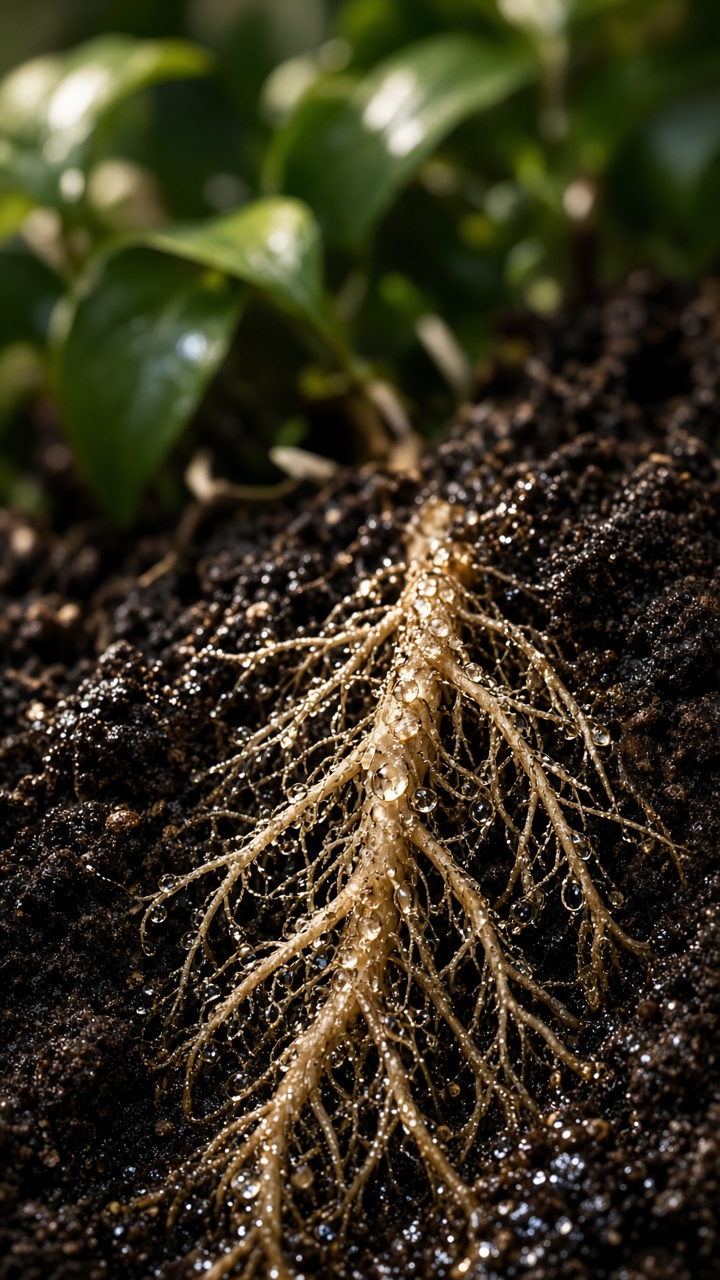
Now compare the above potato slice to plants in a garden being irrigated. To do this, we need to look at the soil as a "solution" made up of the, the soil, the nutrients in the soil, and the water from the irrigation. When the roots of plants are placed in this solution, osmosis will occur. As with the potato slice, the osmosis effect is determined by the salt concentration of the soil solution. So if the soil has the correct sodium content it will be hypertonic, and the plant roots will absorb water from the soil. But on the other hand, if the soil is hypotonic, the soil will steal precious water from the plant roots causing the plant to wither and die.
As plant roots absorb water from the soil, they also absorb the nutrients that have been dissolved into the water. Once inside of the plant, the nutrients are separated from the water and used by the plant as needed.
But all of this biological magic is solely dependant upon one thing, the salt levels of the soil. If the salt levels are too high hypotonic osmosis will occur and water and nutrients will leave the plants through the roots; it will not matter what you plant or how many nutrients are in the soil, nothing will grow. But if the soil has the proper salt levels, hypertonic osmosis will occur and water and nutrient will be absorbed by the plants and the plant will grow healthy and strong.
Potato-slice thought experiment
Hypertonic vs hypotonic conditions reverse the direction of water flow.