Issue 08 · One essay
Seeds vs. Starts
Budget, timing, and a clear-eyed take on what “organic seed” is really buying.
Before we start planting our crops, let's take a moment to talk about seeds. With respect to seeds, there is not a lot of difference between seed brands. In fact, most seed companies are owned by one of three large national chains. What is important when choosing seeds is what kind of plant they will grow. Be careful, just because the package says it’s onion, that doesn't mean it will be the onions you are expecting.
“If you are spending the extra money on organic seeds, I personally think you are wasting your money.”
Seeds vs. Starts
Some of the major characteristics to compare between similar seeds are: size, color, shape, plant style (bush, vine, stalk), growth rates, yield amounts. Other thinks to look at are: water requirements, soil needs, heat and sun recommendations. In summary, know what you are buying.
Organic Seeds? Now there is a big buzz word out there I find to be nothing more than a pain in the behind, "Organic". In my opinion 90% of all the so-called organic products are listed as organic just so they can charge us more for them. And yes, in the world of seeds, there are organic seeds too. So, what exactly would an organic seed be anyway?
It is all about the plants the seeds come from and how they were grown. For example, plants that have been fertilized with manure-based fertilizers, such as steer manure, may not be able to have their seeds classified as organic seeds.
Research has shown that, in some cases, trace amounts of antibiotics and growth hormones given to cattle have been absorbed by plants fertilized with their dung. These additives are then passed along into the seeds of the parent plant and thus on into the child plant as well. Fear is that when the child plant is harvested and consumed by humans, trace amounts of the additives, originally given to the cattle, will be passed off to the human consumers.
So, one of the major criteria for a seed to be considered an organic seed is the seed company must use only manure from cattle that have not been given hormones or antibiotics.
In my opinion it is all a bunch of manure. Consider the size of the seeds in your garden. Exactly how much antibiotic could that little seed be holding? And then how much of that antibiotic could be transferred to the child plant's harvest? I think if I was concerned about these additives ending up in my food I would be worrying about the soil in my garden, the water I was using for irrigation, and the manure I was using to fertilize my crops. So, if you are spending the extra money on organic seeds, I personally think you are wasting your money.
In fact, let me step up on my soap box for a minute here. I have seen many things in my 86 years, and as such I feel I have the right to comment on all of the changes I have seen.
While I do admit that in a perfect world all farming would consist solely of organic based methods, this is just not possible. Our society has become too large for purely organic methods to support. For this to be possible, we would have to revert back to a more agrarian based society. So, until every household has a garden, a complete reversal to organic methods would quite literally cripple the food production of the world. The truth is, as a world, we have become dependent upon our modernized agriculture methods.
Then to complicate matters more, the negative influences of politics and big corporate money have filtered down into the very foods we eat and into our own home gardens. Both side of this debate actively slander the other. As such, the truth becomes buried in a sea of confusion, and we become victims of their marketing games.
Most of the information on organic crops, hybrid seeds, and genetically modified crops are simply propaganda rhetoric used to support or discredit someone's politically motivated agenda. For example, look at the following message about organic seeds provided by the Organic Seed Growers and Trade Association...
"There are numerous reasons for supporting the continued development of organic seed production as well as supporting programs of plant breeding for organic production. The underlying basis for organic agriculture is the concern and interaction of the ecological effects of the inputs into our food supply. The production of conventional seed requires heavier application of chemical pesticides than their food crop counterpart as seed crops are generally in the ground longer, and being a non-food crop, the allowable levels of application are much higher. These include methyl bromide, endosulfan (both of which are banned in the EU and much of the world), metaldehyde and many other highly toxic chemicals that damage air and water quality, biological diversity, and human health. Specialty seed production takes place in highly specialized regions, such as the Skagit and Willamette Valleys of Washington and Oregon. Is it fair for those of us in organic agriculture to want our own farms and environments to be as free of toxins as possible, but expect seed production communities to carry a heavy toxic load so that we can plant cheap conventional seed? However, there is a better reason for supporting investment in and usage of organic seed than the prevention of ecological contamination. Organic agriculture as a whole will find even greater success as we develop truly organic cultivars – organic not just because the seed was produced on organic ground and sold by a company certified to handle organic inputs – but cultivars adapted for low inputs, that exhibit elasticity in the face of environmental extremes, enhance the health of local food systems by extending seasons, increase crop quality (including processing), and that have improved nutritional content. Organic seed adds to the value of organic farming by focusing breeding and selection on traits that are economically and agronomically important to the organic grower and ultimately to the organic consumer, traits that are often neglected in conventional breeding programs.”
This statement clearly shows their political and economically motivated reason for using organic crops. It states that we should buy organic seeds not just for "the prevention of ecological contamination", but more importantly for the "economical and agronomic" concerns of “organic growers”. There are no objective reasons found in the above statement, only self-serving political and economic motivated subjective declarations. We tend to see the same type of language in other environmental communities such as conservationist, global warming enthusiasts, and animal rights activists. They all tend to paint a skewed picture of things seen from their view. Activists have a propensity to leave out all the facts; they are famous for only stating the details that support their cause.
I am a big supporter of the freedom of speech and the freedom to grow what, how, and if you want. But it bothers me when activists use subterfuge to subvert people into agreement through tactics of fear and manipulation. So, I will try to give you the straight facts, based off my 80 plus years of life and gardening experience, without the political rhetoric.
Hybrid Seeds So, what exactly are hybrid seeds, and how are they different from normal seeds? Hybrid seeds are produced by artificial cross-pollinating plants. Hybrid seeds are produced to improve the natural characteristics of the plant. Hybrid plants are created to: improve crop yields, color, size, increased disease resistance, increased insect tolerance, etc.
Over the past 40 years, hybrid seeds have primarily been used throughout the agriculture industry and home garden community. In fact, hybrid seeds are the main reason for the dramatic rise in the late 20th century worldwide crop yields. Following the massive decline of U.S. farms in the 1960's, as our nation’s work force switch from agriculture to industry, the remaining small group of farmers would not have been able to grow the needed food for the world without hybrid seeds.
So why do hybrid seeds have such a bad reputation? Well, when you try to improve upon God's handy work, it does not always go as planned. With all of the wonderful advantages of hybrid seeds, they do have their draw backs. Hybrid seeds are known to produce yields that have a reduced taste when compared to the original "Open-Pollinated" varieties. Open-pollinated crops are known to be a hardier and more flexible then hybrid crops. Also, open-pollinated crops have the ability to adapt to a local ecosystem, where hybrids do not. There is even some evidence to show that hybrid seeds produce crops that are lower in nutritional content then their open pollinated varieties. Finally, the most significant difference between hybrids and open-pollinated crops, is the ability for farmers to use the open-pollinated crop seeds to plant next year’s crops; using second generation hybrid crop seeds produces greatly reduced germination and yield rates.
So, are hybrid seeds evil? Not at all. As with all philosophic dichotomies, the truth usually lies somewhere in the middle. While complete dependence upon hybrid seeds would be an utter mistake, it would also be an enormous mistake of global proportions to neglect the advantages of hybrid seeds.
So now that I am off my soap box; how can you tell if a seed is a hybrid seed or an open-pollinated seed? The easiest way is to look on the seed package itself. Hybrid seeds will be labeled on the package as "Hybrid" or "F1". Some other terms that are used in conjunction with hybrid seeds are: GE or Genetically Modified, GM or Genetically Engineered, and High Response Seeds. All other seeds should be considered open-pollinated or “Heirloom” varieties.
Purchasing Seeds I often get asked where the best place to buy seeds is. And my answer is always, "Wherever is the cheapest." I purchase most of my seeds from Wal-Mart and Kmart. Although there are certain seeds, like my pea seeds, which I have to get from a specialty gardening/farming store like IFA (Intermountain Farmers Association). These specialty stores tend to be a little pricier, but the end result is worth the extra excellence. While seed can be purchased though online catalogs, it is a much better idea to buy your seeds from your local stores. The seeds selected for sale at your local stores are seed varieties that are known to grow well in your local environment.
Storing Seeds Sometimes people wonder about storing seeds. The storage of seeds is simple. Keep them cool, dry, and out of direct sun light. Freezers and refrigerators are excellent places to store seeds. While you do not have to worry about seeds freezing, you do need to keep them free from insects like weevil. It is a good practice to store seeds in small airtight containers with a small amount of insecticide in the container.
The U.S. Department of Agriculture has been researching the long-term seed storage for years at their Seed Bank Facility in Ft. Collins Colorado. The USDA has indicated that there are two important factors in the preservation of seeds: Temperature and moisture content. While an airtight container is crucial to seed storage, canning or vacuum-packing seeds, in order to reduce oxygen, can actually destroy seeds. Focus more on reducing the moisture content of the seeds prior to storage, by drying seeds on a screen. This will increase the shelf-life many years beyond the normal shelf-life. In a future article, we will cover the proper way to harvest and preserve seeds.
Seeds Expiration Dates Another common question I am asked is, “How long are my seeds good for?” When I was in grade school, I remember learning about seeds that were found when English Egyptologist Howard Carter excavated the tomb of King Tut-Ankh-Amen in 1922. Four of these 3,300-year-old bean seeds were planted In the Betsuin garden on the Hirakawa farm. These ancient reportedly seeds sprouted and grew into healthy plants.
Now before you get your hopes up, not all seeds are going to last for 3,000 years. The reason seeds will not last forever is due to the fact the seed is alive and thus it is using up its internal food supply. Once too much of the seed’s food supply is gone, the seed will not have enough energy left to germinate. The germination rate continues to decrease over time until eventually you would better off buying new seeds.
Different seed varieties have varying viability rates. I have included a chart to help you will some of the more common vegetable garden varieties.
Seed Type Years Seed Type Years Asparagus 3-4 New Zealand Spinach 4-5 Beans 3-6 Okra 1-2 Beets 3-4 Onions 2-4 Broccoli 4-5 Parsley 3-5 Brussels Sprouts 4-5 Parsnips 1-3 Cabbage 4-5 Peas 4-6 Cantaloupe 6-10 Peppers (all) 3-5 Carrots 3-5 Potatoes (real seed) 5-7 Cauliflower 4-5 Pumpkins 3-5 Celeriac 4-5 Radish 3-5 Celery 3-5 Rutabaga 3-5 Chicory 4-5 Salsify 3-4 Collards 4-5 Scorzonera 3-4 Corn 4-6 Spinach 3-4 Cucumbers 5-7 Squash (all) 3-5 Eggplants 3-5 Strawberry 3-6 Escarole/Endive 3-4 Sunflower 4-6 Kale 4-5 Swiss Chard 3-4 Kohlrabi 4-5 Tomato 4-7 Leeks 2-4 Turnip 5-8 Lettuce 3-4 Watermelon 4-6 Mustard 5-8
Table SEQ Table \* ARABIC 1 - Seed Storage Data
In case you have any question about whether or not your seeds will germinate, it is a good idea to test a few of them before you plant. To test your seeds, fold several seeds inside of a moist paper towel. Fold the paper towel up carefully to ensure the seeds do not touch. Place the paper towel into the lid of a mayonnaise jar filled with water. Place the Mason jar lid in a warm bright location, like a window seal, but not where it is in direct sun light. Check the seeds every couple of days to make sure they are still wet, and to see if they have germinated. If they have not started to germinate after two weeks, chances are the seeds are not good. Throw the seeds away and go buy some new seeds.
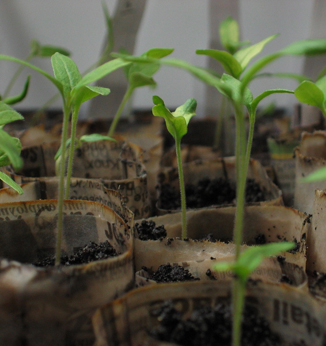
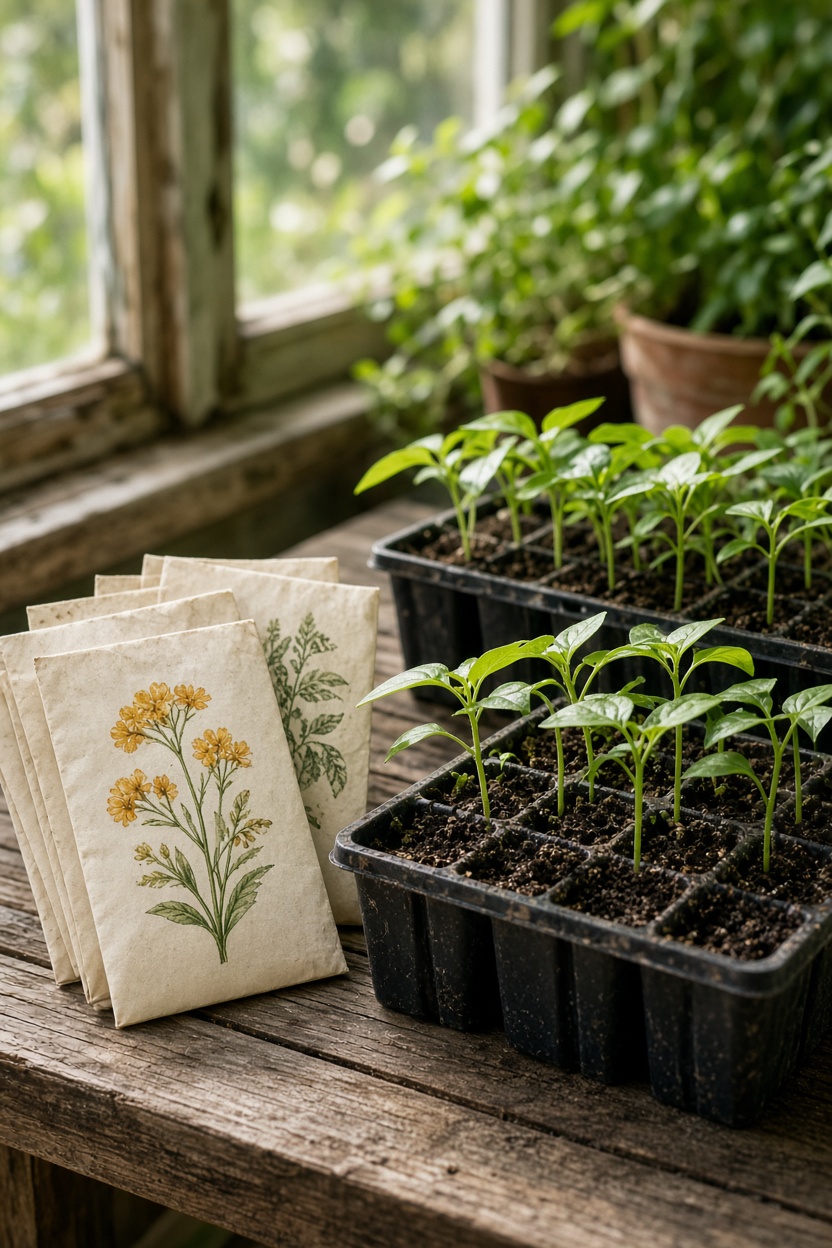
Seeds vs. Starts An age-old gardening paradox is, should I use seeds or should I use starts. For those that are not familiar to the term "starts" or "seedling", it refers to seeds that are grown in small containers, and then once they become small plants, they are transplanted into your garden.
There are several advantages to using starts over seeds, but likewise, they have their disadvantages too. Let's look first at the advantages of using starts.
Using starts, first and for most, gives your garden a significant head start over seeds alone. Starts can be purchased from your local gardening center, or even grown inside your house. In essence, this allows seeds to be planted and grown, safe from frost, much earlier in the year then if they were planted outside. Then when the fear of frost has passed, the starts are moved outside and instantly you have a fully developed garden.
So, what possible disadvantages could there be to using starts? Well first off, if you are purchasing starts from a local nursery, make sure you bring your wallet. Depending upon the plant, starts can cost anywhere from $0.50 to over $10.00 per plant. When compared to a package of 30 to 50 seed for $0.99, starts can quickly become a very expensive way to grow a garden, and the larger the start to higher the price.
Another disadvantage of starts is planting them. It is much more difficult and time consuming to plant starts then it is to plant seeds. Imagine planting an entire 30' row of corn using starts.
Starts also are a pain to get home from the store, they like to fall over and make a mess in your car. And if you grow your own starts, they require a lot of room, good lighting, and constant watering.
So, when it comes down to it, you have to weigh the pros and cons of using starts over seeds. I am confident you will come to the same conclusion as I have, use both. You will find that for certain plants like melons and tomatoes, starts are the only way to go. And for other plants like corn and peas, seeds are the best solution. Until next time, keep those thumbs green.